

Precision in Motion: Global Automotive Wheel Bearings Market Driven by Next-Gen Mobility
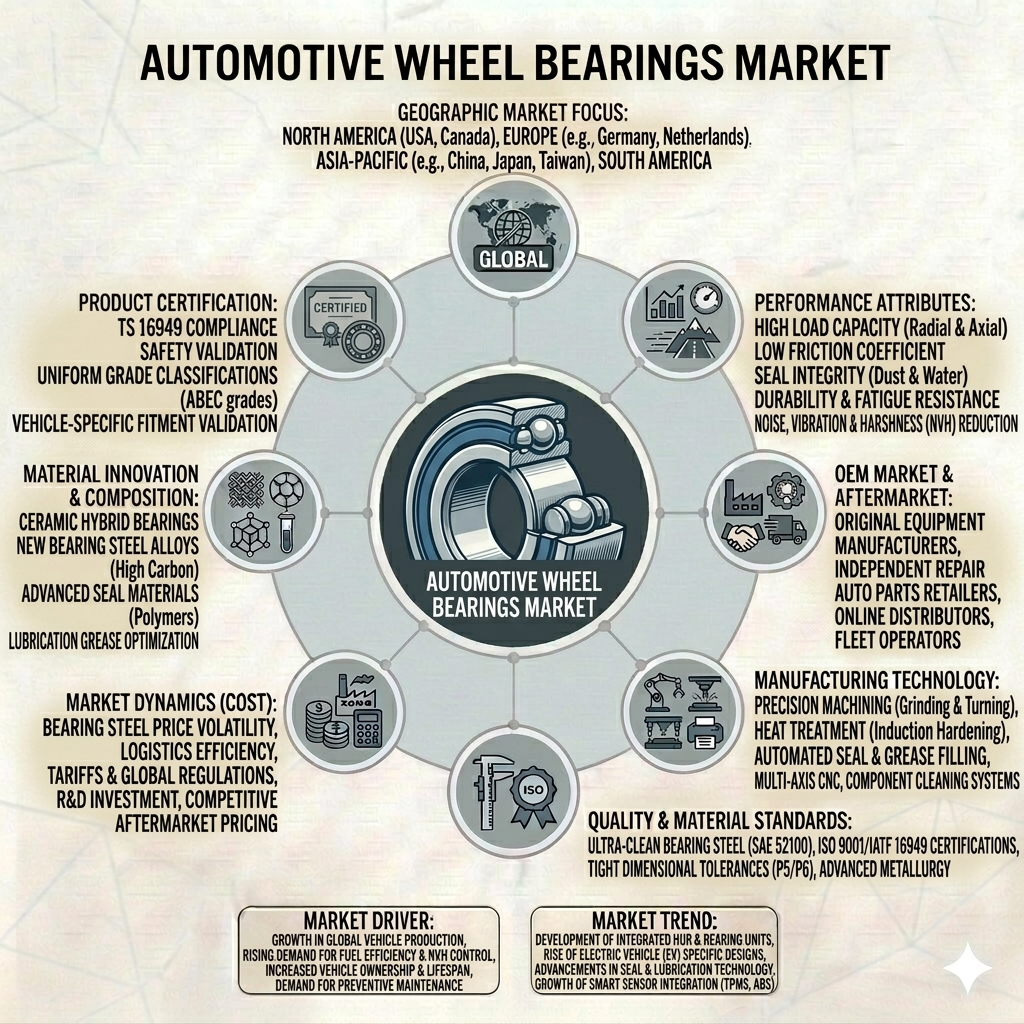
Automotive Wheel Bearings Market
The purpose of bearings is to enable rotational or linear movement and to reduce unnecessary friction between two mating parts.
NEWARK, DE, UNITED STATES, March 27, 2026 /EINPresswire.com/ -- The global automotive wheel bearings market is undergoing a profound structural evolution as the industry pivots toward electrification, autonomous driving, and ultra-high-efficiency vehicle architectures. Once considered a standard mechanical commodity, the wheel bearing has been reimagined as a mission-critical "smart" component, integrating advanced sensing and friction-reduction technologies to meet the demands of modern transportation.
The Electrification Catalyst: Redefining Performance
The rapid transition to Electric Vehicles (EVs) has fundamentally altered the performance requirements for wheel-end components. Unlike traditional internal combustion engines, electric motors deliver maximum torque instantaneously, placing unprecedented stress on bearing raceways.
• Torque Resistance: Modern wheel bearings must now withstand the aggressive acceleration profiles of high-performance EVs. This has led to the widespread adoption of ceramic-hybrid and insulated bearings, which prevent electrical pitting and extend service life.
• The Range Factor: Reducing rolling resistance is now a primary engineering goal. By utilizing specialized low-friction grease and optimized internal geometries, manufacturers are helping OEMs squeeze more miles out of every battery charge.
• Acoustic Excellence: In the absence of engine noise, the "silent cabin" experience of an EV amplifies every mechanical vibration. Tier-1 suppliers are now deploying high-precision finishing techniques to ensure near-silent operation at high rotational speeds.
Get Access of Report Sample:
https://www.futuremarketinsights.com/reports/sample/rep-gb-3409
Technological Shift: From Gen 1 to Smart Hub Units
The market is rapidly moving away from individual bearing components toward fully integrated Hub Bearing Units (HBUs). This transition simplifies the manufacturing process and significantly improves vehicle safety.
1. Gen 3 & 4 Integration: These units combine the bearing, hub, and mounting flange into a single, pre-adjusted assembly. By integrating the wheel speed sensors directly into the hub, manufacturers provide the high-fidelity data required for Advanced Driver Assistance Systems (ADAS) and Anti-lock Braking Systems (ABS).
2. Weight Optimization: To offset the weight of heavy battery packs, the industry is increasingly utilizing lightweight materials, including aluminum and high-strength specialized steels. Newer designs have achieved weight reductions of up to 10% without compromising structural integrity.
3. Predictive Maintenance: The latest "Smart Hubs" feature embedded temperature and vibration sensors. These units can communicate directly with a vehicle's onboard computer to predict mechanical wear, allowing for "just-in-time" servicing that prevents roadside failures.
Regional Growth and Market Dynamics
The center of gravity for bearing production and consumption continues to shift toward the Asia-Pacific region, led by massive vehicle production volumes and aggressive electrification mandates.
• China and India: These markets remain the primary engines of volume growth, supported by expanding logistics networks and a surge in passenger vehicle ownership.
• Europe and North America: In these regions, growth is characterized by a "value-over-volume" trend. Demand is concentrated on high-performance, premium-tier bearings that comply with strict CO2 emission standards and safety regulations.
Strategic Outlook: Overcoming Global Challenges
While the market benefits from the shift to EVs, it faces headwinds from volatile raw material costs and complex global logistics. Manufacturers are responding by regionalizing their supply chains to ensure resilience and investing heavily in sustainable manufacturing. Leading players have already initiated circular economy programs, focusing on the remanufacturing and recycling of large-scale bearing units for commercial fleets.
The competitive landscape remains dominated by a core group of engineering giants, including SKF, Schaeffler, NSK, NTN, JTEKT, and Timken. These companies are increasingly moving beyond hardware, offering comprehensive "Wheel-End Solutions" that combine hardware, software, and data analytics to define the future of vehicle handling and safety.
Frequently Asked Questions (FAQ)
1. Why are EV bearings more expensive than traditional ones?
EV bearings are engineered to handle much higher torque and rotational speeds (often reaching 20,000 RPM). They frequently use specialized materials like ceramic balls or advanced coatings to prevent electrical erosion, which increases the manufacturing cost but significantly improves durability.
2. How does a "Smart Bearing" improve safety?
By integrating magnetic encoders and sensors directly into the hub, smart bearings provide real-time data on wheel speed, temperature, and vibration. This data is essential for the split-second decisions made by emergency braking and stability control systems.
3. What is the difference between a Ball Bearing and a Roller Bearing in a wheel?
Ball bearings are generally preferred for passenger cars because they offer lower friction and better high-speed performance. Roller bearings (specifically tapered rollers) are used in heavy-duty trucks and SUVs because they have a larger contact area, allowing them to carry much heavier loads.
Sudip Saha
Future Market Insights Inc.
+1 347-918-3531
email us here
Legal Disclaimer:
EIN Presswire provides this news content "as is" without warranty of any kind. We do not accept any responsibility or liability for the accuracy, content, images, videos, licenses, completeness, legality, or reliability of the information contained in this article. If you have any complaints or copyright issues related to this article, kindly contact the author above.
