

Global Bundling Machine Market to Reach USD 5.3 Bn by 2035 | Asia Pacific Leads Automation Boom; Krones AG, Sidel Group
bundling machine market
Brazil bundling machine demand grows at 7.2% CAGR, driven by beverage expansion, consumer goods growth, and rising investment in automated production systems.
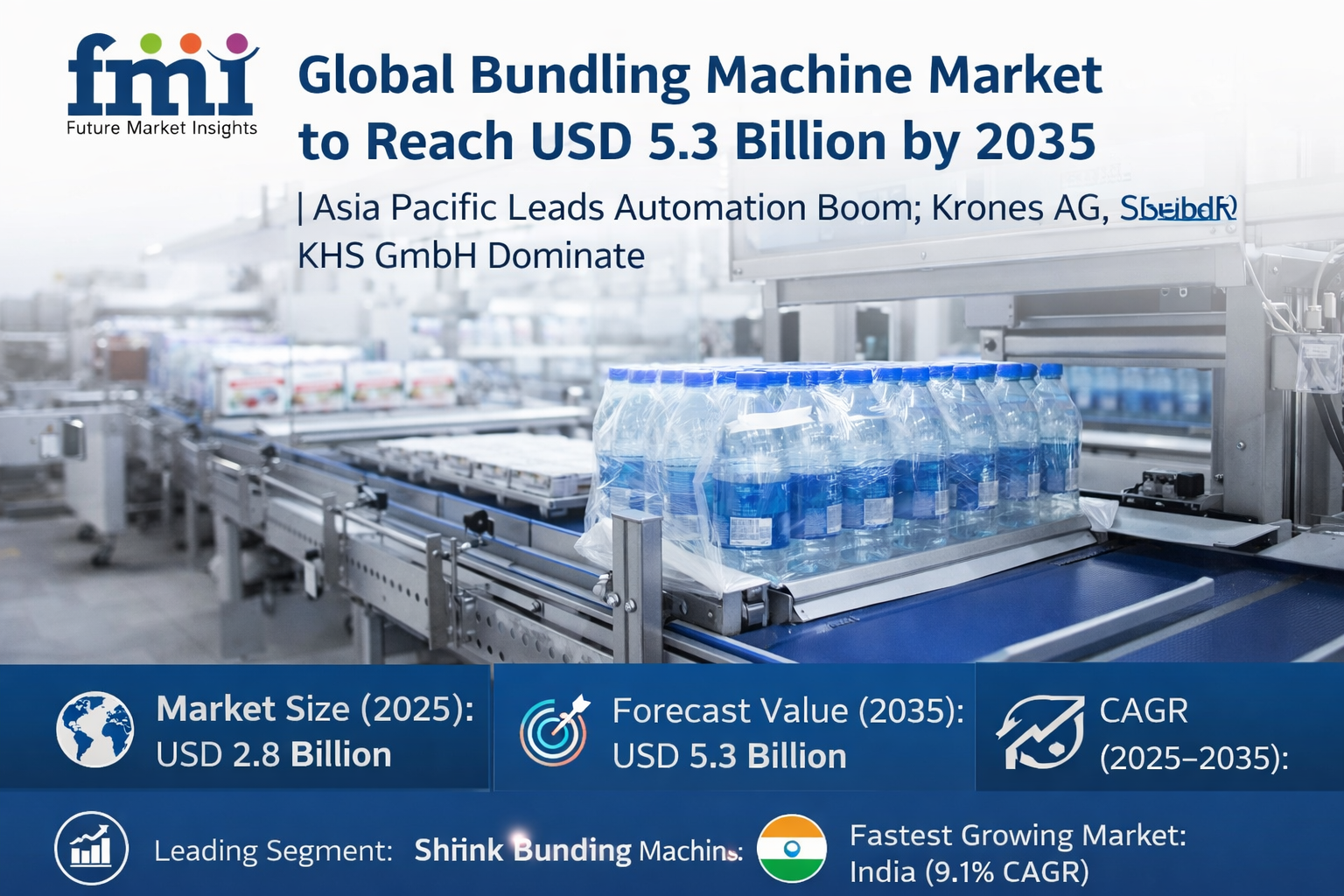
NEWARK , DE, UNITED STATES, March 31, 2026 /EINPresswire.com/ -- The global bundling machine market is valued at USD 2.8 billion in 2025 and is projected to reach USD 5.3 billion by 2035, expanding at a CAGR of 6.6%. The market is undergoing a structural shift from conventional packaging equipment to high-speed, automated, and digitally integrated bundling systems. This transformation is being driven by rising demand for multi-pack beverage formats, retail-ready packaging, and logistics optimization, positioning bundling machines as essential assets in modern production ecosystems rather than standalone equipment.
The evolution of the market is closely tied to automation-driven manufacturing, where bundling machines are integrated into end-to-end packaging lines. Regulatory requirements for food safety, pharmaceutical compliance, and packaging consistency are reinforcing the need for precision-driven equipment.
Bundling Machine Market: Quick Stats:
• Market Size (2025): USD 2.8 Billion
• Forecast Value (2035): USD 5.3 Billion
• CAGR (2025–2035): 6.6%
• Leading Segment: Shrink Bundling Machines (46.2% share)
• Leading End Use: Food & Beverages (42.8% share)
• Fastest Growing Market: India (9.1% CAGR)
Get Access of Research Report Sample: https://www.futuremarketinsights.com/reports/sample/rep-gb-8876
Market Perspective: Bundling Machines as Core Infrastructure for High-Speed Production Lines
Bundling machines are evolving into critical nodes within automated packaging and distribution systems, directly influencing throughput, cost efficiency, and supply chain performance. For manufacturers, this shift means bundling equipment is no longer a downstream add-on but a strategic investment impacting production uptime, labor optimization, and packaging consistency.
Procurement strategies are increasingly focused on total cost of ownership (TCO), including energy efficiency, film consumption, and maintenance predictability. From a compliance standpoint, bundling machines must ensure consistent pack integrity, traceability, and alignment with food-grade and pharmaceutical packaging standards, making advanced control systems and validation capabilities essential.
Key Growth Drivers:
1. Expansion of Beverage and Ready-to-Consume Packaging
The rapid growth of bottled beverages, canned drinks, and ready-to-drink products is driving demand for high-speed bundling systems. Manufacturers require equipment capable of forming stable multi-pack configurations with high throughput and consistent quality, especially in retail-driven markets.
2. Automation and Labor Optimization in Manufacturing
Rising labor costs and workforce constraints are pushing industries toward fully automated bundling solutions. Servo-driven systems and robotic handling technologies enable continuous operation, reduced downtime, and improved operational efficiency, particularly in high-volume production environments.
3. Growth of E-commerce and Logistics Packaging
E-commerce expansion is increasing the need for secure, transport-ready bundling formats. Bundling machines play a key role in ensuring product stability during transit, reducing damage rates, and optimizing packaging for distribution networks.
4. Increasing Demand for Flexible and Multi-Format Packaging
Manufacturers are shifting toward flexible production systems that can handle multiple product sizes and configurations. Bundling machines with quick changeover capabilities and modular designs are gaining traction to support dynamic production requirements.
Strategic Industry Trends
• Circular Economy Initiatives: Focus on film reduction and recyclable packaging materials to meet sustainability targets.
• Automation & Robotics: Integration of robotic arms and intelligent handling systems for flexible bundling operations.
• Material Efficiency: Development of optimized shrink films and reduced energy consumption systems.
• Digital Integration: Adoption of IoT-enabled monitoring, predictive maintenance, and real-time analytics.
Segment Insights:
• By Machine Type: Shrink bundling machines dominate with 46.2% share, driven by their strong load stability, product visibility, and suitability for beverage applications.
• By End Use Industry: Food & beverages lead with 42.8% share, supported by high-volume production and multi-pack demand.
• By Automation Level: Fully automatic machines are gaining traction due to efficiency and reduced labor dependency.
• By Technology: Heat seal bundling remains dominant due to reliability and cost-effectiveness.
• By Production Capacity: High-speed machines (>60 bundles/min) are increasingly preferred in large-scale manufacturing.
Operational Insights:
Industry Challenges
• High initial capital investment for advanced systems
• Complexity in integrating bundling machines into existing production lines
• Competition from alternative secondary packaging solutions
• Requirement for skilled operators and technical expertise
• Fluctuations in packaging material costs
Strategic Responses
• Adoption of modular and scalable machine architectures
• Investment in training and digital interfaces for ease of operation
• Development of energy-efficient and low-maintenance systems
• Integration of vision systems for quality assurance
• Expansion of after-sales service and support networks
Regional Outlook:
• Asia Pacific: Fastest-growing region, led by India (9.1% CAGR) and China (7.8%), driven by beverage industry expansion and manufacturing automation.
• North America: Moderate growth with the United States (5.9%), focusing on advanced automation and Industry 4.0 adoption.
• Europe: Stable growth led by Germany (5.6%) and Italy (6.1%), supported by strong machinery manufacturing capabilities.
• Latin America: Brazil (7.2%) shows strong potential due to rising packaged food and beverage demand.
Competitive Landscape: Consolidation & Capability Advantage
The bundling machine market is characterized by intense competition among global packaging machinery leaders, with differentiation driven by automation capabilities, system integration, and performance reliability. Companies with strong expertise in servo technology, robotics, and digital connectivity are gaining a competitive edge.
Key Companies:
• Krones AG
• Sidel Group (Tetra Laval)
• KHS GmbH
• SMI Group
• Aetna Group
• Schneider Packaging Equipment
• ARPAC LLC
• Smipack S.p.A.
• Robopac-Dimac
• Standard-Knapp Inc.
Strategic Activities
• Mergers & Acquisitions: Expansion of automation portfolios and geographic reach
• Technology Investments: Development of robotic bundling and vision inspection systems
• Capacity Expansion: New manufacturing facilities in Asia Pacific
• Product Innovation: Launch of IoT-enabled and energy-efficient bundling machines
Future Outlook
The bundling machine market will increasingly align with smart manufacturing ecosystems, where machines are interconnected, data-driven, and capable of self-optimization. Future innovations will focus on AI-based quality inspection, predictive maintenance, and fully autonomous packaging lines. As production environments become more complex and demand variability increases, bundling machines will serve as critical enablers of agility, efficiency, and supply chain resilience.
Frequently Asked Questions (FAQs)
1. What is the market size in 2025?
The bundling machine market is valued at USD 2.8 billion in 2025.
2. What is the forecast value by 2035?
The market is projected to reach USD 5.3 billion by 2035.
3. What are the key growth drivers?
Key drivers include beverage industry expansion, automation adoption, e-commerce growth, and flexible packaging demand.
4. Which segment leads the market?
Shrink bundling machines lead with a 46.2% share.
5. Which region is growing the fastest?
India is the fastest-growing market with a 9.1% CAGR.
Why FMI: https://www.futuremarketinsights.com/why-fmi
Explore More Research Reports by FMI:
UN-Certified PCR Plastic Chemical Drums Market : https://www.futuremarketinsights.com/reports/un-certified-pcr-plastic-chemical-drums-market
IoT-Tracked Reusable IBC Fleet Market https://www.futuremarketinsights.com/reports/iot-tracked-reusable-ibc-fleet-market
Mono-Material Industrial Steel Pail Liners : https://www.futuremarketinsights.com/reports/mono-material-industrial-steel-pail-liners
Bio-Based PE Skincare Tubes Market : https://www.futuremarketinsights.com/reports/bio-based-pe-skincare-tubes-market
Cyclic Olefin Polymer (COP) Injectable Vials Market : https://www.futuremarketinsights.com/reports/cyclic-olefin-polymer-cop-injectable-vials-market
About Future Market Insights (FMI)
Future Market Insights (FMI) is a globally recognized market research and consulting firm, delivering data-driven insights across industries. With a strong focus on actionable intelligence, FMI supports organizations in navigating complex market transitions and identifying growth opportunities.
Sudip Saha
Future Market Insights Inc.
+1 347-918-3531
rahul.singh@futuremarketinsights.com
Legal Disclaimer:
EIN Presswire provides this news content "as is" without warranty of any kind. We do not accept any responsibility or liability for the accuracy, content, images, videos, licenses, completeness, legality, or reliability of the information contained in this article. If you have any complaints or copyright issues related to this article, kindly contact the author above.
