

Global Titanium Dioxide Market Led by Asia Pacific; Chemours, Tronox, and LB Group Strengthen Pigment Supply Chains
Titanium Dioxide
Titanium Dioxide Market is segmented by Grade (Rutile Grade, Anatase Grade), Application (Paints & Coatings, Plastics) and Region. Forecast for 2026 to 2036
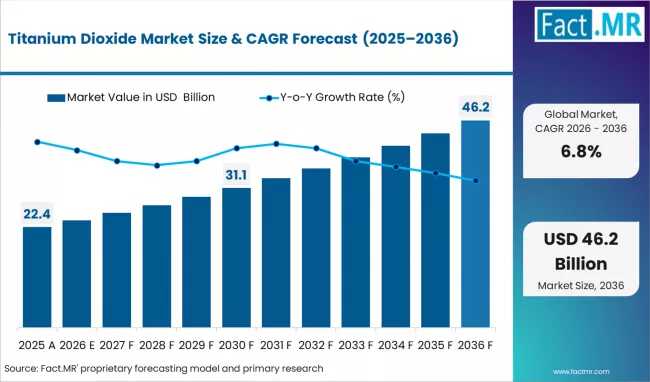
ROCKVILLE, MD, UNITED STATES, April 9, 2026 /EINPresswire.com/ -- According to Fact.MR’s latest analysis, the global titanium dioxide market is witnessing steady expansion driven by strong demand from paints & coatings, plastics, and construction sectors. The market was valued at USD 22.40 billion in 2025, is projected to reach USD 23.92 billion in 2026, and is forecast to grow to USD 46.19 billion by 2036, registering a CAGR of 6.8%.The industry is expected to generate an incremental opportunity of USD 22.27 billion during the forecast period. Titanium dioxide remains the dominant white pigment globally due to its unmatched refractive index, superior opacity, and UV resistance. The market is transforming as chloride-route production, feedstock integration, and specialty pigment development become key competitive differentiators.
Get detailed market forecasts, competitive benchmarking, and pricing trends:
https://www.factmr.com/connectus/sample?flag=S&rep_id=4641
Quick Stats
Market Size (2026): USD 23.92 Billion
Market Size (2027): USD 25.55 Billion (est.)
Forecast Value (2036): USD 46.19 Billion
CAGR (2026–2036): 6.8%
Incremental Opportunity: USD 22.27 Billion
Leading Segment: Rutile Grade (~76% share)
Leading Region: Asia Pacific
Key Players: Chemours, Tronox Holdings, LB Group, Venator Materials, KRONOS Worldwide
Executive Insight for Decision Makers
The titanium dioxide market is shifting from price-driven procurement to supply reliability and pigment performance consistency.
Strategic shift
Paint manufacturers prioritizing long-term supply contracts
Growing preference for chloride-route pigments
Increasing demand for surface-treated specialty grades
What stakeholders must do
Secure feedstock integration for cost stability
Invest in chloride-route production capacity
Develop specialty grades for waterborne coatings and plastics
Risk of not adapting
Manufacturers dependent on sulfate-route production face rising environmental compliance costs and risk losing large coating industry contracts.
Market Dynamics
Key Growth Drivers
Expansion of construction and architectural coatings demand
Growth in plastics masterbatch and packaging industries
Automotive production and refinishing coatings demand
Rising infrastructure investments in emerging economies
Key Restraints
Volatility in titanium feedstock pricing
Environmental regulations on sulfate-route production
High capital investment for chloride-route plants
Emerging Trends
Shift toward chloride-route production technology
Surface-treated pigments for waterborne coatings
Specialty TiO₂ for high-performance plastics
Sustainable low-VOC coating formulations
Segment Analysis
Leading Segment
Rutile grade dominates with approximately 76% market share
Fastest Growing Segment
Plastics coloration and masterbatch applications
Breakdown
By Grade: Rutile | Anatase
By Application: Paints & Coatings | Plastics | Others
By End-use: Construction | Automotive | Packaging | Consumer goods
Strategic Importance
Paints & coatings ensure bulk demand, while plastics and specialty pigments offer higher margins and innovation opportunities.
Supply Chain Analysis
Raw Material Suppliers
Titanium ore miners (ilmenite, rutile)
Synthetic rutile producers
Chemical feedstock suppliers
Manufacturers / Producers
Titanium dioxide pigment manufacturers
Chloride and sulfate route processing plants
Distributors
Chemical distributors
Coatings raw material suppliers
Plastics compound distributors
End Users
Paint and coatings manufacturers
Plastics processors and masterbatch producers
Paper and packaging companies
Automotive OEM coating suppliers
Who Supplies Whom
Titanium ore suppliers provide feedstock to TiO₂ producers. Manufacturers process pigments and supply coatings and plastics companies. Distributors support smaller formulators. End users integrate pigments into paints, plastics, and specialty products.
Pricing Trends
Commodity pricing for standard rutile pigments
Premium pricing for surface-treated specialty grades
Key pricing factors:
Titanium feedstock cost
Production route (chloride vs sulfate)
Quality consistency requirements
Long-term supply agreements
Margin Insight
Higher margins achieved in specialty pigments and chloride-route production.
Regional Analysis
Top Countries by CAGR
India – 7.5%
China – 7.3%
United States – 6.6%
Brazil – 6.4%
Japan – 5.9%
Regional Growth Drivers
India: Construction and coatings demand
China: Domestic production and plastics growth
USA: Chloride-route production capacity
Brazil: Automotive and construction coatings
Japan: High-purity specialty pigment demand
Developed vs Emerging Markets
Emerging markets drive volume demand
Developed markets focus on specialty high-performance pigments
Competitive Landscape
The titanium dioxide market is moderately consolidated with leading players controlling significant share.
Key Players
Chemours Company
Tronox Holdings plc
LB Group Co., Ltd.
Venator Materials PLC
KRONOS Worldwide Inc.
Ishihara Sangyo Kaisha
CNNC Hua Yuan Titanium Dioxide
PRECHEZA a.s.
Tayca Corporation
Evonik Industries
Competitive Strategies
Feedstock integration
Chloride-route technology investment
Specialty pigment innovation
Long-term supply agreements
Strategic Takeaways
For Manufacturers
Invest in chloride-route production technology
Develop specialty surface-treated pigments
For Investors
Target Asia Pacific expansion opportunities
Focus on sustainable pigment technologies
For Marketers / Distributors
Emphasize supply continuity and pigment performance
Expand partnerships with coatings manufacturers
Future Outlook
The titanium dioxide market is expected to benefit from construction growth, plastics demand, and sustainable coating technologies. Specialty pigments, chloride-route expansion, and feedstock integration will define competitive advantage.
Long-term opportunities include:
High-performance coatings
Packaging plastics coloration
Sustainable low-VOC formulations
Specialty pigments for advanced applications
Conclusion
The global titanium dioxide market is transitioning toward performance-driven pigment procurement, where supply stability, process efficiency, and specialty grade development determine market leadership. Companies investing in advanced production technologies and emerging market expansion are positioned to capture growth from the USD 46.19 billion opportunity by 2036.
Why This Market Matters
Critical pigment for coatings and plastics
Enables durability and UV protection
Supports infrastructure and construction growth
Drives innovation in sustainable coatings
Full Report: Unlock 360° insights for strategic decision making and investment planning-
https://www.factmr.com/checkout/4641
To View Related Report:
Titanium Dioxide Industry Analysis in Australia https://www.factmr.com/report/titanium-dioxide-industry-analysis-in-australia
Titanium Dioxide Nanoparticles Market https://www.factmr.com/report/4837/titanium-dioxide-nanoparticles-market
Titanium Dioxide Nanomaterials Market https://www.factmr.com/report/698/titanium-dioxide-nanomaterials-market
Titanium Dioxide Pigment Market https://www.factmr.com/report/2531/titanium-dioxide-pigment-market
S. N. Jha
Fact.MR
+1 628-251-1583
email us here
Legal Disclaimer:
EIN Presswire provides this news content "as is" without warranty of any kind. We do not accept any responsibility or liability for the accuracy, content, images, videos, licenses, completeness, legality, or reliability of the information contained in this article. If you have any complaints or copyright issues related to this article, kindly contact the author above.
