

Your top news on global issues
Provided by AGP
Industry Research Reveals the 3 Disciplines That Define Top-Performing Property Asset Management Firms

Enterprise asset management systems provide full visibility across multiple properties and locations
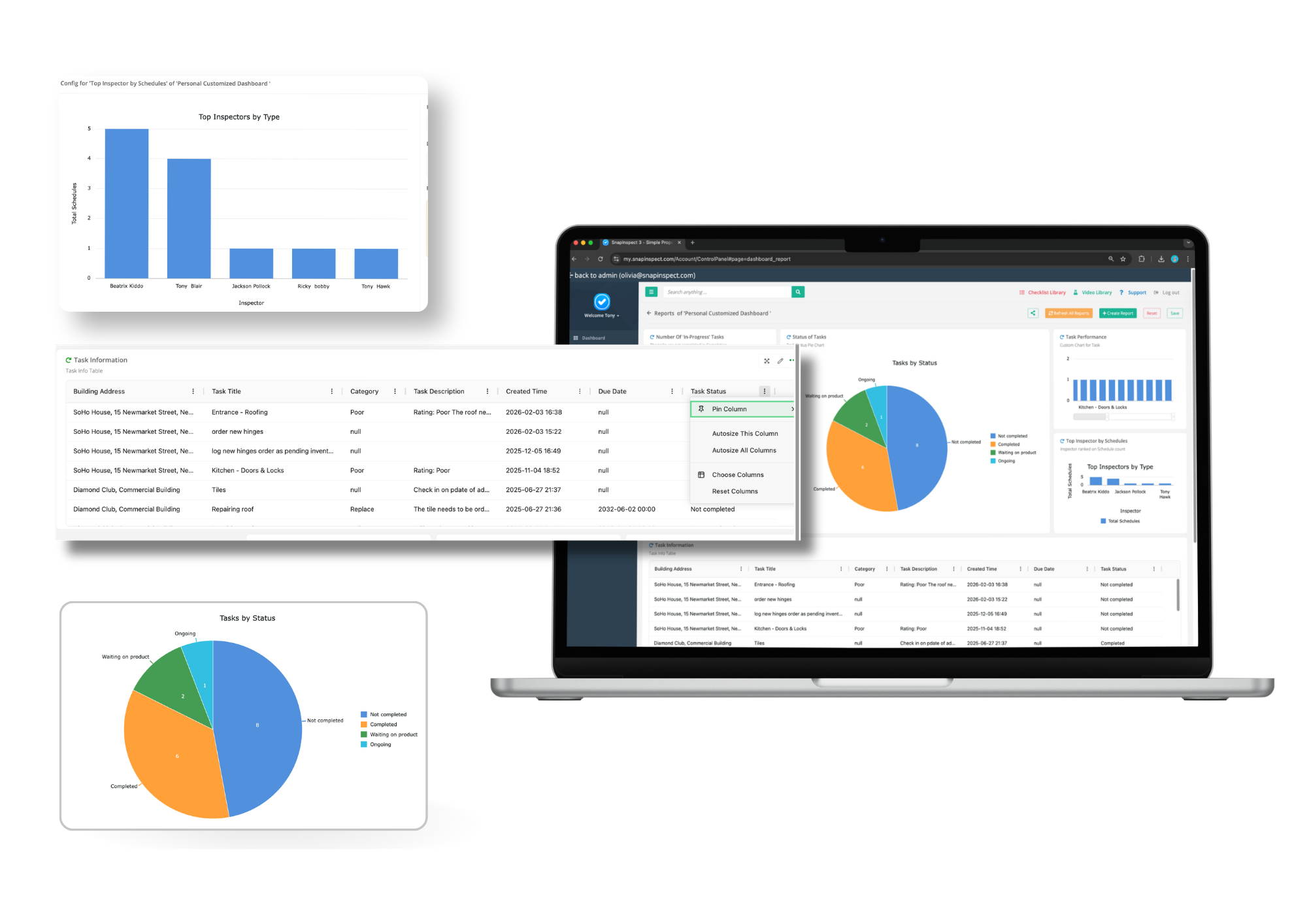
SnapInspect’s analytics dashboard gives enterprise teams real-time visibility into property performance, inspections, and asset conditions
New analysis of post-GFC performance data identifies the intentional patterns that separated high-growth property asset management firms from the rest.
It is not the strongest of the species that survives, nor the most intelligent, but the ones most adaptable to change.”
SAN DIEGO , CA, UNITED STATES, May 5, 2026 /EINPresswire.com/ -- As global equity and bond markets continue navigating geopolitical volatility, new analysis of asset management industry data has identified a clear set of operational disciplines that consistently separate high-performing firms from the broader market. The findings draw on performance patterns observed in the decade following the Global Financial Crisis (GFC) of 2007–2009, which was infact, a period now recognised as one of the most instructive stress tests in modern asset management history.— Charles Darwin
The research offers a timely benchmark for asset managers, owners, and limited partners (LPs) reassessing their competitive positioning heading into a decade defined by hybrid work environments, deglobalisation, fragmented regulation, ESG obligations, and rising demand for personalised investment solutions.
A Small Cohort of Firms Rewrote the Post-GFC Playbook
In the years following the Global Financial Crisis, a group of approximately 20 of the world's 50 largest asset management firms demonstrated measurably superior performance across true key metrics. These firms grew their collective share of total industry revenue from 24% to 32%, a significant difference for their bottom lines. They served up annual profit growth of 10% per year, compared to 8% for the broader industry. They were 1.3 times more productive per employee. Furthermore, they went on to invest 2% more of their revenues in technology, year on year, than their peers.
The cohort was not defined by product category. It was not one booming niche industry by any means. It included alternative managers, passive strategies, fixed income specialists, and solutions-focused firms, a diversified melting pot. What they shared was a common operating discipline, one that researchers and industry analysts are now pointing to as a framework for the decade ahead.
3 Disciplines That Contribute to Outperformance
1. Strategic Repositioning Over Market Optimism
The firms that pulled ahead after the GFC didn't bet on broad market recovery. They were increasingly targeting and refining identified structural shifts early and moved before the opportunity became crowded. Low interest rates and bank lending contractions created openings in active fixed income and private markets. Accelerating flows toward passive strategies and ETFs changed the competitive landscape for active managers. And rapid growth in retail, wealth, and retirement segments rewarded firms that pivoted toward individual investors rather than waiting for institutional mandates to recover.
The same dynamic applies today. Private credit, infrastructure, real assets, and technology-enabled advisory models represent the structural tailwinds that define the current cycle. The firms building capability in these areas now are positioned to capture disproportionate net flows as the opportunity matures.
2. Changing Models: Tweaking Operations and workflows in Business
Among the clearest differentiators between outperforming and underperforming firms was how they approached operational modernization. The firms that won did not simply update their technology stack. They restructured how the entire business operated around better data, faster decision-making, and a more consistent client experience.
Investment processes improved. Sales productivity increased. Operational risk declined. Talent retention strengthened because the internal experience was better.
Critically, the shift was as much cultural as technological. At leading firms, data and technology levelled up to core strategic functions, equal partners with the business, not cost centres to be minimized. Innovation became a daily expectation and ingrained behaviour rather than a project with a defined end date. It was a shift in the goal posts for daily operations
For asset managers running real asset portfolios, property, infrastructure, or mixed-use funds, this operating model evolution is directly relevant to how physical assets are managed and reported. Standardised portfolio-wide condition management, automated maintenance tracking, and investment-grade reporting capability are increasingly expected by both institutional investors and regulators. Firms that cannot demonstrate this level of operational rigour are at a growing disadvantage in LP due diligence processes.
3. Financial Discipline as a Competitive Strategy
Asset management remains one of the most financially attractive industries globally, with median profit margins exceeding 30% and strong cash generation across cycles. But those same characteristics can obscure poor spending discipline. In the decade following the GFC, non-compensation costs across the industry rose from approximately 22% of revenues to more than 30% — a structural cost creep that eroded reinvestment capacity at many firms.
The firms that outperformed maintained tighter financial control, freeing up capital for reinvestment in the areas that actually drive growth: technology, talent, client experience, and new capability development.
For real asset and property fund managers, financial discipline connects directly to asset lifecycle management. Reactive maintenance is materially more expensive than planned maintenance. Inaccurate condition data leads to poor acquisition, hold, and disposal decisions. And unplanned capital expenditure disrupts distributions and erodes investor confidence. Firms with real-time condition data and accurate maintenance forecasting are better positioned to protect net operating income and produce the reliable asset valuation models that underpin fund performance reporting.
Agility as an Operating Principle
Beyond these three disciplines, the analysis identifies a further characteristic shared by top-performing firms: a consistent preference for iterative progress over perfect planning.
Rather than running 18-month transformation programmes, leading firms piloted changes on a subset of their portfolio, measured results, and scaled what worked. They shifted resources quickly toward high-value initiatives and away from lagging ones. Annual waterfall funding cycles were replaced by continuous investment frameworks tied to demonstrated outcomes.
In an environment where markets, regulation, and client expectations are all moving fast, this capacity for structured agility has become a source of durable competitive advantage.
The Window to Act Is Narrowing
Industry observers note that the gap between asset management firms that have genuinely modernised their operating infrastructure and those still relying on legacy processes is widening. In a bull market, that gap is manageable. In a bear market, it is very difficult to close.
The three disciplines identified in the post-GFC data — targeted growth investment, operating model modernisation, and financial management discipline — remain the consistent variables that separate winning firms from the rest. What has changed is the urgency.
Asset managers, owners, and LPs who take these disciplines seriously over the next decade are positioned to define the
Mike Tatum
SnapInspect
+1 888-883-8046
email us here
Visit us on social media:
LinkedIn
Instagram
Facebook
YouTube
X
Legal Disclaimer:
EIN Presswire provides this news content "as is" without warranty of any kind. We do not accept any responsibility or liability for the accuracy, content, images, videos, licenses, completeness, legality, or reliability of the information contained in this article. If you have any complaints or copyright issues related to this article, kindly contact the author above.
