

The Fluid Foundation of Industry: How the Global Lubricants Market Is Evolving Toward USD 212.56 Billion by 2035
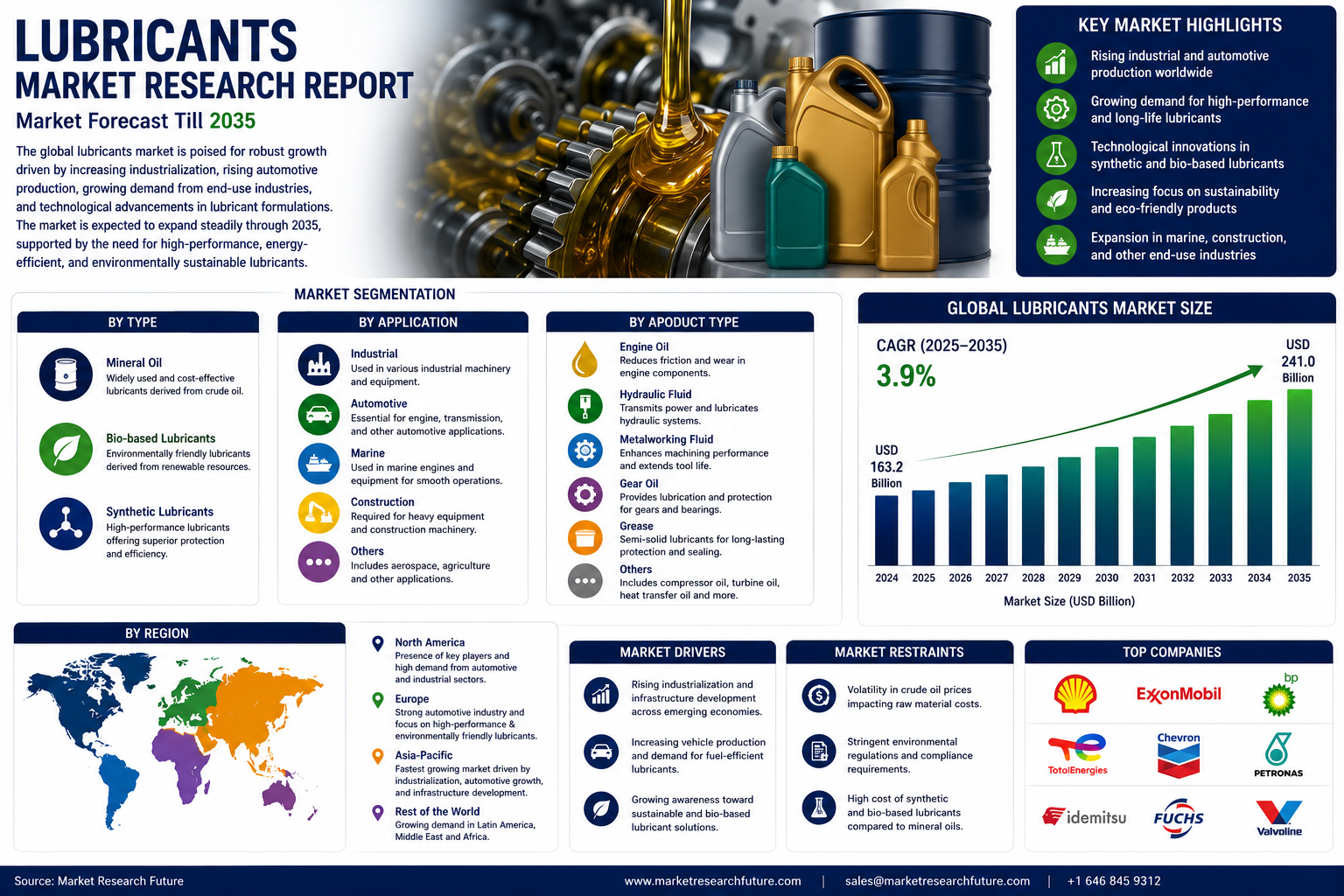
lubricants market
Asia-Pacific commands roughly 48.7% of the global Lubricants Market, anchored by China and India's combined vehicle fleet of over 420 million units.
EUROPE, FRANCE, June 25, 2026 /EINPresswire.com/ -- Every engine that turns, every gear that meshes, every turbine that spins, and every hydraulic system that actuates depends on one thing: lubrication. Lubricants are the invisible enablers of the modern industrial world — reducing friction, dissipating heat, preventing corrosion, and extending the operational life of machinery across virtually every sector of the global economy. And while the energy transition is reshaping the landscape of this industry, the lubricants market is proving its resilience by evolving, innovating, and expanding into new high-value applications.According to a comprehensive analysis by Market Research Future, the global lubricants market reached USD 168.50 billion in 2025 and is projected to grow from USD 172.46 billion in 2026 to USD 212.56 billion by 2035, registering a compound annual growth rate (CAGR) of 2.35% during the forecast period. This steady and sustained expansion reflects the market's enduring structural importance — underpinned by global fleet growth, industrial expansion, and the emergence of new fluid applications driven by electrification and renewable energy.
The Forces Shaping the Market
Regulatory-driven reformulation is one of the most immediate and impactful drivers reshaping the lubricants market. Tightening fuel economy mandates — including the EU's Euro 7 emission standard and China's VI-b heavy-duty regulation — are compelling original equipment manufacturers to adopt lower-viscosity formulations across their vehicle lineups. Automakers are systematically reducing recommended viscosity grades, from SAE 5W-30 to 0W-20 and even 0W-16, to extract incremental fuel-economy gains and meet fleet-average emissions targets. Japanese OEMs have already specified 0W-8 grades for select hybrid powertrains, establishing a technology trajectory that strongly favors formulators with Group III and polyalphaolefin (PAO) base-stock capabilities.
Asia-Pacific industrialization is the second major demand engine, accounting for approximately 48.7% of global market share in 2025. China's advanced manufacturing programs and India's Production-Linked Incentive scheme are collectively channeling over USD 90 billion into heavy industry, electronics, and automotive assembly — each new manufacturing facility bringing recurring demand for hydraulic fluids, metalworking coolants, and gear oils. India, in particular, stands out as the fastest-growing major national market in the region, driven by 22 million annual motorcycle sales and an agricultural tractor fleet exceeding 9 million units.
Download Report Sample Copy with TOC: https://www.marketresearchfuture.com/sample_request/5449
The renewable energy buildout is adding a compelling new demand stream that is often overlooked in discussions of the market's future. The International Renewable Energy Agency projects global installed wind capacity to reach 1.4 terawatts by 2030. Each utility-scale wind turbine consumes 300–500 liters of high-performance gear oil, replaced on three-to-five-year maintenance cycles — creating a predictable, high-margin aftermarket stream that directly benefits the lubricants market. Offshore installations demand even more specialized corrosion-inhibiting and thermally robust fluids, further lifting revenue-per-unit for formulators with the technical capability to serve this demanding segment.
Electrification: Disruption and Opportunity
The rise of battery electric vehicles is the most discussed challenge facing the lubricants market — but the picture is considerably more nuanced than a simple narrative of engine oil displacement. Hybrid powertrains, projected to constitute approximately 35% of new global vehicle sales by 2030, retain full crankcase oil requirements alongside new e-axle fluid demands — a dual-fluid architecture that actually increases per-vehicle lubricant complexity. Meanwhile, battery electric vehicles introduce entirely new fluid categories: dielectric coolants, immersion cooling fluids, and e-axle transmission oils. With forecasters projecting 40 million annual BEV sales by 2030, each requiring three to eight liters of specialized thermal fluids priced at four to six times the per-liter value of conventional motor oil, electrification is as much a margin opportunity as a volume challenge.
Segment and Technology Highlights
Engine oils remain the dominant product category, generating 55.2% of revenue in 2025, anchored by the global vehicle fleet of over 1.4 billion units. Specialty products — including EV thermal management fluids — are the fastest-growing product segment. Among base stocks, mineral oil retains 71% of volume, but bio-based formulations are the fastest-growing category, growing at a CAGR of 3.48% through 2035, supported by the EU Ecolabel scheme and corporate sustainability procurement targets that are making lifecycle carbon credentials an active purchasing criterion.
Group III base stocks are the market's most strategically significant growth segment, expanding at 3.25% CAGR driven by OEM viscosity-downgrade programs and extended drain intervals. Major capacity investments from SK Enmove, S-Oil, and Saudi Arabia's Luberef are collectively adding over three million metric tons of annual Group III supply by 2028 — compressing the price gap with Group II and enabling blenders to offer synthetic-grade performance at near-mineral-oil economics.
Purchase Now: https://www.marketresearchfuture.com/checkout?currency=one_user-USD&report_id=5449
The Middle East and Africa region records the steepest regional CAGR at 3.45%, propelled by Saudi Vision 2030 infrastructure spending and expanding refining capacity anchored by Luberef and ADNOC — positioning the region as both a fast-growing demand center and an increasingly important base-stock supply hub for Africa and South Asia.
Related Report
Chlor-Alkali Market https://www.marketresearchfuture.com/reports/chlor-alkali-market-1966
Isocyanates Market https://www.marketresearchfuture.com/reports/isocyanate-market-964
Geosynthetics Market https://www.marketresearchfuture.com/reports/geosynthetics-market-8809
Fluoropolymers Market https://www.marketresearchfuture.com/reports/fluoropolymers-market-3226
Adhesives & Sealants Market https://www.marketresearchfuture.com/reports/adhesives-sealants-handheld-devices-market-3865
Market Research Future
Market Research Future
+ +1 855-661-4441
email us here
Legal Disclaimer:
EIN Presswire provides this news content "as is" without warranty of any kind. We do not accept any responsibility or liability for the accuracy, content, images, videos, licenses, completeness, legality, or reliability of the information contained in this article. If you have any complaints or copyright issues related to this article, kindly contact the author above.
