

Global Workwear Market to Reach USD 26.35 Billion by 2035 Amid Rising Workplace Safety and Sustainability Demand
Workwear market
Rising demand for worker protection, sustainable materials, smart technologies, and regulatory compliance is fueling global workwear market growth.
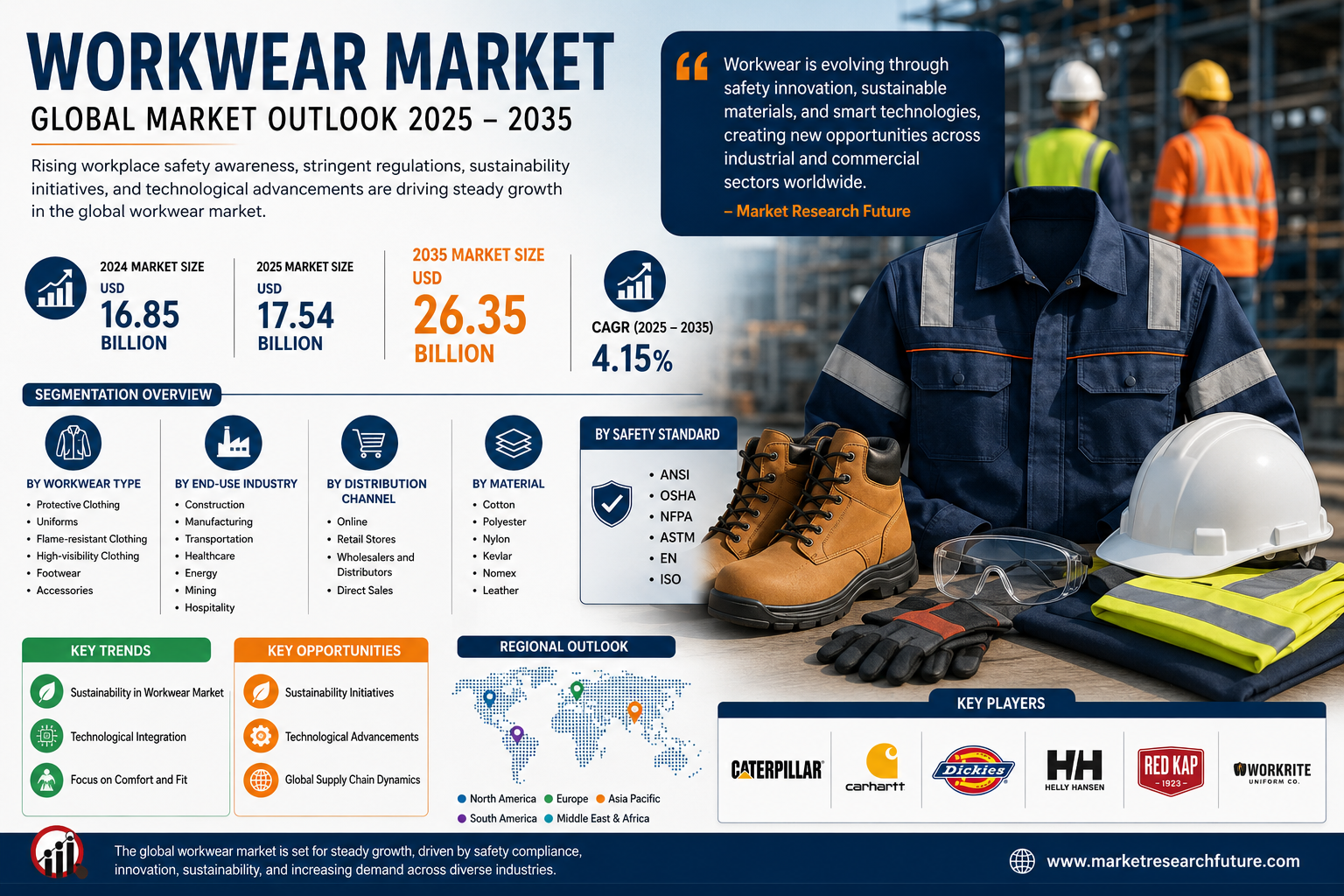
Workwear is evolving through safety innovation, sustainable materials, and smart technologies, creating new opportunities across industrial and commercial sectors worldwide.”
NEW YORK, NY, UNITED STATES, June 25, 2026 /EINPresswire.com/ -- The global Workwear Market is witnessing substantial growth as industries worldwide continue to prioritize employee safety, operational efficiency, and regulatory compliance. According to the latest market analysis, the global workwear market was valued at USD 16.85 billion in 2024 and is projected to grow from USD 17.54 billion in 2025 to USD 26.35 billion by 2035, registering a Compound Annual Growth Rate (CAGR) of 4.15% during the forecast period.— Market Research Future (MRFR)
Workwear has evolved far beyond traditional uniforms and protective garments. Today, organizations across construction, manufacturing, healthcare, transportation, energy, mining, and hospitality sectors increasingly view workwear as an essential component of workplace safety, employee comfort, brand identity, and productivity enhancement.
The growing implementation of stringent workplace safety regulations across developed and emerging economies is significantly accelerating demand for advanced protective clothing, flame-resistant apparel, high-visibility garments, safety footwear, and specialized accessories.
Market Growth Driven by Workplace Safety Regulations
The increasing focus on occupational health and safety remains one of the primary factors driving market growth. Governments and regulatory agencies worldwide continue to strengthen safety standards aimed at reducing workplace accidents and injuries.
Industries such as construction, oil and gas, mining, manufacturing, and transportation are particularly dependent on protective workwear solutions designed to safeguard workers from physical, chemical, thermal, and environmental hazards.
Organizations are investing heavily in certified workwear products that comply with internationally recognized standards including ANSI, OSHA, NFPA, ASTM, EN, and ISO requirements. Compliance with these standards helps employers reduce workplace risks while maintaining operational continuity and workforce well-being.
As industrial operations become increasingly complex and technologically advanced, demand for specialized protective clothing is expected to grow steadily throughout the forecast period.
Get Full PDF Sample Copy of Report: (Including Full TOC, List of Tables & Figures, Chart) @ https://www.marketresearchfuture.com/sample_request/26851
Sustainability Emerging as a Major Industry Trend
Sustainability has become a transformative trend reshaping the global workwear landscape. Companies are increasingly seeking environmentally responsible solutions that align with corporate sustainability goals and ESG commitments.
Manufacturers are responding by introducing workwear products made from recycled materials, organic cotton, sustainably sourced fibers, and environmentally friendly manufacturing processes. Circular economy initiatives, including garment recycling and take-back programs, are also gaining traction across the industry.
Many end users now evaluate suppliers not only based on product quality and safety performance but also on environmental impact and ethical sourcing practices. This shift is encouraging significant innovation in sustainable textiles and production technologies.
Industry experts believe that sustainability-focused product development will become a key competitive differentiator for market participants over the next decade.
Technological Integration Transforming Modern Workwear
Technological advancements are creating new opportunities across the workwear sector. Manufacturers are incorporating innovative materials, smart fabrics, wearable technologies, and performance-enhancing features into next-generation workwear products.
Advanced moisture management systems, temperature regulation capabilities, antimicrobial treatments, lightweight protective materials, and ergonomic designs are improving both worker safety and comfort.
Emerging smart workwear solutions are also attracting attention. These garments can integrate sensors capable of monitoring worker health indicators, environmental conditions, fatigue levels, and exposure to hazardous substances.
Such innovations are particularly valuable in high-risk industries where real-time monitoring can contribute to accident prevention and improved workforce management.
As digital transformation continues to influence industrial operations, technologically enhanced workwear solutions are expected to gain broader adoption globally.
Increasing Focus on Comfort and Employee Experience
Modern employers increasingly recognize the connection between worker comfort, job satisfaction, and productivity. As a result, workwear manufacturers are placing greater emphasis on fit, flexibility, breathability, and ergonomic performance.
Employees working long shifts in physically demanding environments require garments that provide protection without compromising comfort or mobility. This demand has encouraged innovation in fabric technology, garment construction, and customized sizing solutions.
The trend is especially evident in sectors such as healthcare, hospitality, logistics, and manufacturing, where workers often wear uniforms or protective clothing throughout the workday.
Organizations are increasingly selecting workwear solutions that balance durability, safety compliance, and wearer comfort, contributing to higher employee acceptance and operational efficiency.
Segment Analysis
By Workwear Type
The market is segmented into Protective Clothing, Uniforms, Flame-resistant Clothing, High-visibility Clothing, Footwear, and Accessories.
Protective clothing remains a dominant category due to increasing workplace safety requirements across industrial sectors. This segment is supported by rising demand for multi-hazard garments, chemical-resistant apparel, cut-resistant clothing, and insulated outerwear used in high-risk environments. Flame-resistant clothing continues to experience strong demand from energy, utilities, oil and gas, and manufacturing industries, where compliance with fire safety standards and exposure protection are critical purchasing factors. In many industrial settings, flame-resistant garments are now being procured as part of mandatory safety programs rather than optional protective gear, which is strengthening repeat demand and replacement cycles.
High-visibility clothing is gaining popularity in transportation, construction, and infrastructure projects where worker visibility is critical for accident prevention. Reflective jackets, vests, and trousers are increasingly being specified for road crews, logistics workers, warehouse staff, and night-shift personnel. Safety footwear and related accessories also represent important growth areas as organizations adopt comprehensive worker protection programs. Demand for steel-toe boots, slip-resistant shoes, puncture-resistant soles, gloves, helmets, and protective eyewear is rising as employers move toward bundled safety solutions that reduce injury risk across multiple work environments.
Uniforms continue to hold a strong position in sectors such as healthcare, hospitality, retail, and corporate services, where appearance, hygiene, and brand consistency are important. In healthcare, uniforms are often selected for antimicrobial properties, easy laundering, and comfort during long shifts. In hospitality and service industries, uniforms are increasingly designed to combine professional presentation with ergonomic fit and durable fabrics that can withstand frequent washing. Across all workwear types, customization, embroidery, logo placement, and color-coded garment systems are becoming more common as companies seek to reinforce identity and improve workforce organization.
By End-Use Industry
Key end-use industries include Construction, Manufacturing, Transportation, Healthcare, Energy, Mining, and Hospitality.
Construction remains one of the largest consumers of workwear products due to high safety compliance requirements and ongoing infrastructure development worldwide. Workers in this sector require durable, weather-resistant, and high-visibility garments that can withstand harsh outdoor conditions and heavy physical activity. Manufacturing facilities continue to invest in protective apparel to support worker safety and regulatory adherence. In manufacturing environments, workwear demand is influenced by exposure to machinery, heat, sharp tools, chemicals, and repetitive motion, which increases the need for specialized garments and protective accessories.
Transportation and logistics are also major contributors to market demand, particularly as global freight movement, warehousing, and last-mile delivery operations expand. Employees in these sectors often require high-visibility clothing, safety footwear, and weather-adaptive uniforms to support long shifts and varied working conditions. Healthcare organizations require specialized uniforms and protective garments designed for hygiene, infection control, and professional appearance. The healthcare segment is increasingly adopting disposable and reusable protective apparel, especially in hospitals, laboratories, elder care facilities, and emergency response settings.
Meanwhile, energy and mining sectors represent significant opportunities for advanced flame-resistant and hazard-protection clothing. These industries often operate in extreme environments where workers face exposure to heat, sparks, electrical hazards, dust, and heavy equipment. As a result, demand is strong for garments that meet strict safety certifications and provide long-lasting durability. The hospitality sector is increasingly adopting premium uniforms that enhance employee comfort while reinforcing brand image and customer experience. In this segment, purchasing decisions are often influenced by aesthetics, fabric softness, stain resistance, and ease of maintenance, alongside cost efficiency and replacement frequency.
By Distribution Channel
The market is segmented into Online, Retail Stores, Wholesalers and Distributors, and Direct Sales.
Digital commerce is rapidly transforming workwear procurement practices. Online channels are experiencing accelerated growth as businesses seek convenient purchasing options, broader product selection, and streamlined procurement processes. E-commerce platforms are particularly attractive to small and medium-sized enterprises that require flexible ordering, transparent pricing, and quick replenishment of standard workwear items. Online sales are also benefiting from improved product comparison tools, size guides, customization options, and subscription-based replenishment models for recurring purchases.
Traditional retail stores and distributors continue to play a vital role, particularly for organizations requiring product demonstrations, fitting services, and customized solutions. Physical channels remain important for buyers who need to assess fabric quality, garment fit, safety certifications, and durability before placing bulk orders. Wholesalers and distributors are especially significant in industrial markets where large-volume procurement, inventory management, and regional supply support are essential. These intermediaries often serve as key partners for enterprises operating across multiple sites or geographic locations.
Direct sales channels remain important for large enterprises seeking tailored workwear programs and long-term supplier partnerships. This channel is commonly used by organizations that require customized uniforms, branded apparel, managed inventory systems, and contract-based supply agreements. Direct sales also allow manufacturers to work closely with clients on compliance requirements, garment specifications, and lifecycle management. As procurement becomes more data-driven, many buyers are adopting hybrid purchasing models that combine online ordering convenience with distributor support and direct account management.
By Material
The market includes Cotton, Polyester, Nylon, Kevlar, Nomex, and Leather materials.
Cotton continues to be widely used due to comfort and breathability characteristics. It remains a preferred choice for uniforms and general-purpose workwear, especially in environments where softness, moisture absorption, and all-day wearability are important. Polyester and nylon remain popular for durability and performance applications. These synthetic materials are valued for their resistance to wear and tear, quick-drying properties, and ability to retain shape after repeated washing, making them suitable for industrial uniforms and outdoor workwear.
High-performance materials such as Kevlar and Nomex are increasingly utilized in hazardous environments where superior protection against heat, flames, and physical hazards is required. Kevlar is widely used in cut-resistant gloves, reinforced garments, and protective accessories, while Nomex is commonly selected for flame-resistant clothing in energy, electrical, and emergency response applications. Demand for these advanced materials is being supported by stricter safety regulations and the growing need for multi-functional garments that combine protection, comfort, and durability.
Leather maintains strong demand in protective footwear and specialized industrial applications. It is valued for abrasion resistance, toughness, and long service life, particularly in heavy-duty work environments. In addition, blended fabrics and engineered textile combinations are gaining traction as manufacturers seek to improve performance across multiple criteria, including breathability, flexibility, thermal protection, and wash durability. Material innovation is becoming increasingly important as end users look for workwear that can deliver both compliance and comfort without increasing replacement costs.
Regional Outlook
North America remains a significant market due to strong occupational safety regulations, industrial activity, and widespread adoption of premium workwear solutions.
Europe continues to demonstrate steady growth driven by strict workplace safety standards, sustainability initiatives, and technological innovation in textile manufacturing.
Asia-Pacific is expected to emerge as one of the fastest-growing regional markets throughout the forecast period. Rapid industrialization, infrastructure development, expanding manufacturing sectors, and increasing awareness of workplace safety are supporting regional demand.
South America is witnessing gradual adoption of modern workwear solutions as industries strengthen safety compliance measures.
Meanwhile, the Middle East and Africa region offers considerable growth potential driven by construction projects, energy sector investments, mining activities, and workforce safety initiatives.
Competitive Landscape
The global workwear market remains highly competitive, with leading manufacturers focusing on innovation, sustainability, product differentiation, and strategic partnerships.
Major market participants include:
• Caterpillar
• Carhartt
• Dickies
• Helly Hansen
• Red Kap
• Workrite Uniform Company
These companies continue to invest in research and development to enhance product performance, improve worker comfort, integrate sustainable materials, and address evolving customer requirements.
Strategic collaborations, geographic expansion, product portfolio diversification, and digital sales channel development remain key competitive strategies shaping the industry landscape.
Future Opportunities
Several factors are expected to create substantial growth opportunities in the coming years.
Sustainability initiatives will continue influencing purchasing decisions across industries, encouraging innovation in eco-friendly materials and circular manufacturing practices.
Technological advancements, including smart textiles and wearable safety technologies, are expected to unlock new revenue streams and value-added product categories.
Global supply chain optimization and localization efforts may also create opportunities for manufacturers to improve resilience, reduce costs, and enhance customer responsiveness.
As organizations increasingly prioritize employee safety, well-being, and operational efficiency, demand for advanced workwear solutions is expected to remain strong throughout the forecast period.
Discover Related Research Reports By Market Research Future:
Womens Activewear Market
https://www.marketresearchfuture.com/reports/womens-activewear-market-34567
Womens Luxury Footwear Market
https://www.marketresearchfuture.com/reports/womens-luxury-footwear-market-40529
Office Supplies Market
https://www.marketresearchfuture.com/reports/office-supplies-market-12019
Sagar Kadam
Market Research Future
+1 628-258-0071
email us here
Visit us on social media:
LinkedIn
Facebook
YouTube
X
Legal Disclaimer:
EIN Presswire provides this news content "as is" without warranty of any kind. We do not accept any responsibility or liability for the accuracy, content, images, videos, licenses, completeness, legality, or reliability of the information contained in this article. If you have any complaints or copyright issues related to this article, kindly contact the author above.
