

Sun Yat-Sen University Researchers Investigate Serum Progesterone as a Predictor for Frozen–Thawed Embryo Transfer
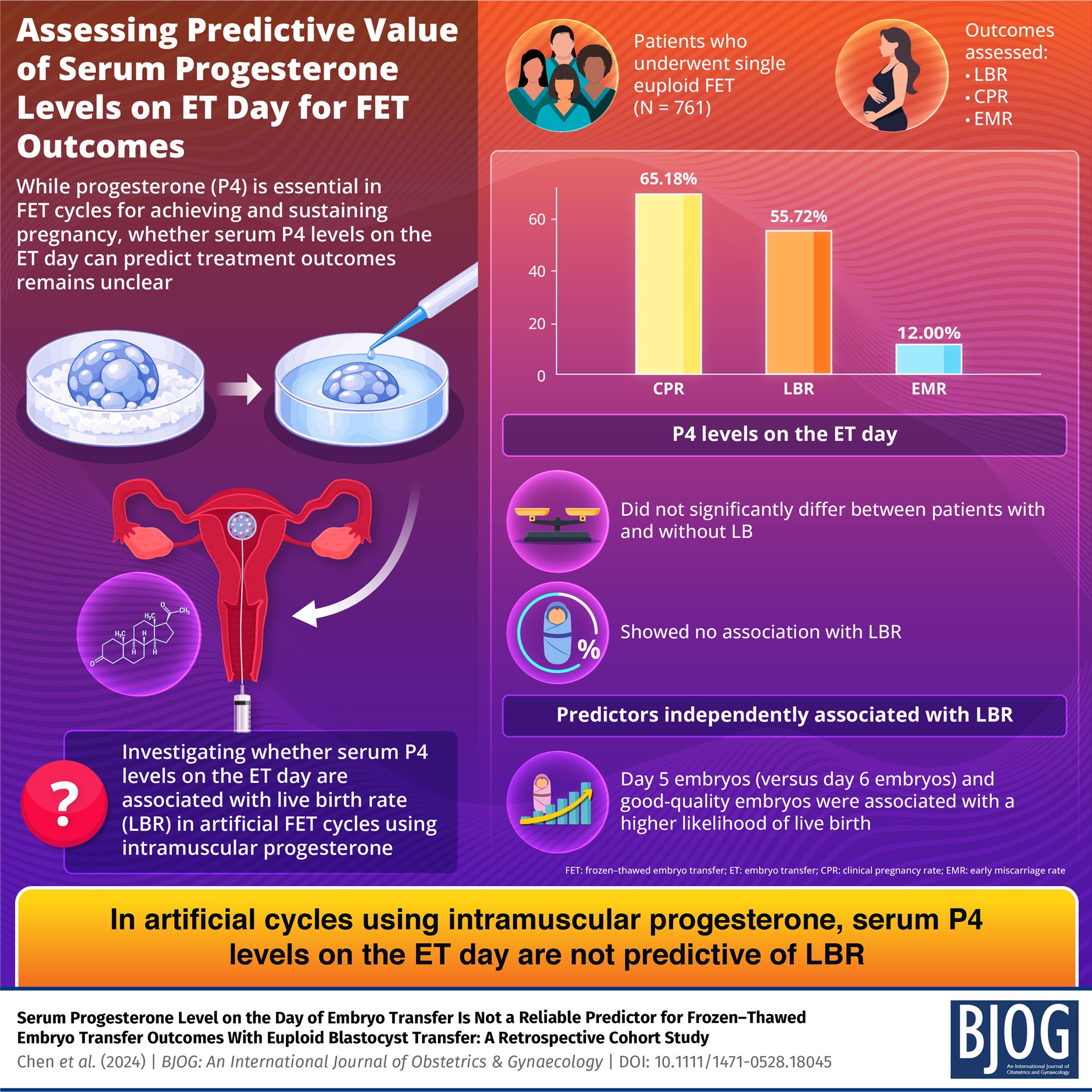
A recent study published in BJOG: An International Journal of Obstetrics & Gynaecology revealed that serum progesterone level on embryo transfer day is not strongly associated with pregnancy success in frozen–thawed embryo transfer, with the probability o
Researchers assess the reliability of serum progesterone level on embryo transfer day as a predictor for frozen-thawed embryo transfer
GUANGZHOU, CHINA, September 1, 2026 /EINPresswire.com/ -- Frozen–thawed embryo transfer (FET) has become a cornerstone of modern in vitro fertilization (IVF). The process involves thawing a previously cryopreserved embryo and inserting it into a prepared uterus. In an artificial FET cycle, the endometrial environment is regulated with hormone supplementation, often resulting in higher success rates and reduced risk.Progesterone (P4) plays a critical role in this process, preparing the uterine lining for implantation and maintaining early embryo development. Some studies suggest that a minimum serum P4 level on embryo transfer (ET) day predicts FET success, while others contradict this. These inconsistencies might arise because these studies did not account for embryo-related factors and focused on vaginal P4 supplementation, often with varying doses and administration schedules. Intramuscular (IM) progesterone, on the other hand, is cost-effective and produces more stable plasma levels. Whether the association between serum P4 and FET outcomes, observed with vaginal supplementation, holds in patients using IM progesterone remains unclear.
To address this research gap, a group of researchers from China, led by Dr. Fang Gu and Dr. Yanwen Xu from The First Affiliated Hospital of Sun Yat-Sen University, China, assessed whether serum P4 levels measured on the ET day can reliably predict pregnancy success in FET cycles. Dr. Gu explains, “We examined single euploid (chromosomally normal) FET cycles using a standard IM progesterone dose to see how useful P4 measurement on ET day actually is, ruling out the possibility that the failure of implantation was linked with the embryo’s chromosomal abnormality.” Their findings were made available online on December 17, 2024, and published in the journal BJOG: An International Journal of Obstetrics & Gynaecology on April 15, 2025.
The research team retrospectively analyzed clinical data from patients undergoing hormone replacement therapy-FET, supported by P4 supplementation. Pregnancy outcomes, including live birth rate (LBR), clinical pregnancy rate, and early pregnancy loss, were compared across three categories of serum P4 level on ET day. With this, the investigators aimed to determine whether a specific hormone threshold could predict the likelihood of achieving a live birth.
The results suggested that the P4 level on ET day was not strongly associated with pregnancy success. The overall LBR was around 55%, and P4 levels were comparable between patients with LB and those without. Patients with both relatively lower and higher P4 levels on the day of transfer were able to achieve successful pregnancies.
Further analysis revealed that other factors appeared to play a crucial role in determining outcomes. The developmental stage of the blastocyst, the day five embryo in comparison to the day six embryo, and overall embryo quality were more strongly associated with LBR than the P4 measurement taken on the day of transfer.
“The findings of our study indicated that a single serum progesterone measurement taken on ET day cannot serve as a reliable predictor of success in frozen ET cycles,” mentions Dr. Gu, talking about the significance of the study. P4 remains essential for establishing and maintaining pregnancy. However, IVF outcomes depend on a combination of factors, and there is a complex biological process underlying implantation. Serum P4 levels on ET day alone may not give a complete picture of the conditions required for successful implantation. Randomized controlled trials are required to assess the effectiveness of P4 measurements and subsequent dose adjustment to improve outcomes.
The study contributes to an expanding corpus of research investigating the most effective ways for clinicians to monitor and maximize hormonal support during fertility treatment. The results indicate that a wider range of clinical indicators should be considered when making treatment decisions.
A better understanding of the biological factors influencing implantation and pregnancy success may help improve treatment strategies and outcomes for IVF patients.
Reference
Title of original paper: Serum Progesterone Level on the Day of Embryo Transfer Is Not a Reliable Predictor for Frozen–Thawed Embryo Transfer Outcomes With Euploid Blastocyst Transfer: A Retrospective Cohort Study
Journal: BJOG: An International Journal of Obstetrics & Gynaecology
DOI: https://doi.org/10.1111/1471-0528.18045
About the First Affiliated Hospital of Sun Yat-Sen University, China
The First Affiliated Hospital of Sun Yat-sen University (FAH-SYSU) in Guangzhou, established in 1910, is a premier, 3A-rated comprehensive teaching hospital. Renowned for pioneering organ transplantation in China, it performed the nation's first successful kidney transplant and the world's first ischemia-free liver/heart transplants. It has 5 National Key Disciplines accredited by the Ministry of Education and 36 National Key Clinical Specialties by the National Health Commission. The institution has multiple research faculties and has conducted 589 national-level research projects in the last five years, published 75 original research publications in globally recognized academic journals, and won two second-prize National Science and Technology Progress Awards.
Website: https://www.fahsysu.org.cn/en/home
About Dr. Fang Gu and Dr. Yanwen Xu from First Affiliated Hospital of Sun Yat-Sen University, China
Dr. Fang Gu, MD, PhD, is an associate professor of Obstetrics and Gynecology from the First Affiliated Hospital of Sun Yat-sen University, Guangzhou, China. She specializes in reproductive endocrinology and assisted reproductive technology (ART). Her clinical and research interests are endometrial polyp, embryo implantation, chronic endometritis, and ART safety. Her work has been published in more than 20 publications to date.
Dr. Yanwen Xu is a prominent Reproductive Medicine specialist and Professor at the Reproductive Medical Center of The First Affiliated Hospital of Sun Yat-sen University in China. She is also affiliated with the Reproductive Medical Center, Guangdong Provincial Key Laboratory of Reproductive Medicine. She specializes in infertility, assisted reproductive technology (ART), and preimplantation genetic testing (PGT), with research focusing on chronic endometritis and IVF outcomes. Her work has been published in more than 100 publications till date.
Funding information
This study was supported by the National Key Research and Development Program of China (2023YFC2705503), the National Natural Science Foundation of China (82001499), and the Guangdong Basic and Applied Basic Research Foundation (2022A1515011955).
Jing Ma
Wiley
+86 1085419367
email us here
Legal Disclaimer:
EIN Presswire provides this news content "as is" without warranty of any kind. We do not accept any responsibility or liability for the accuracy, content, images, videos, licenses, completeness, legality, or reliability of the information contained in this article. If you have any complaints or copyright issues related to this article, kindly contact the author above.
