

Representative Sub-Sampling Under Scrutiny: Technical Evolution of Benchtop Rotary Sample Dividers
News originally published by
EIN Presswire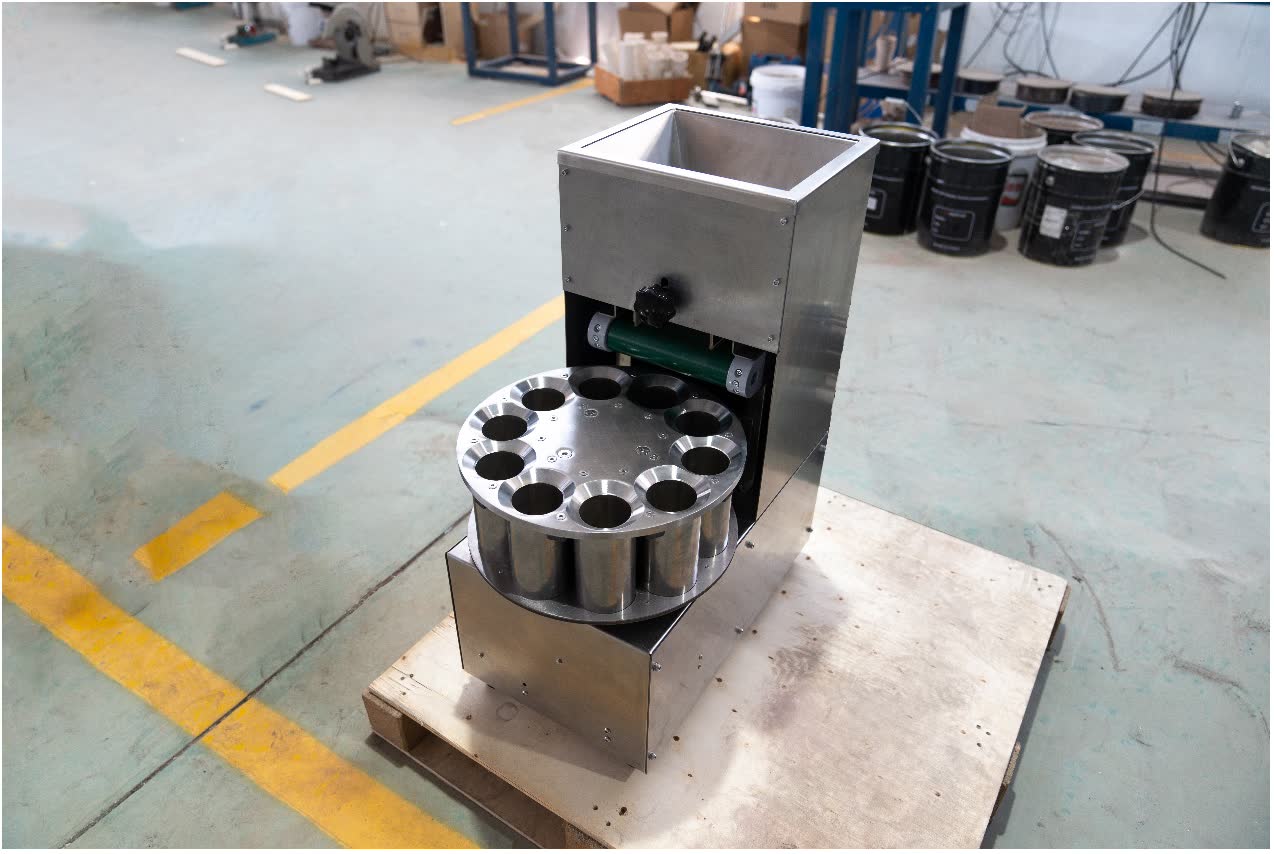
Laboratory practitioners have long grappled with this challenge. Manual coning-and-quartering and static riffle-splitters represent well-established approaches, yet each carries inherent practical limitations under modern high-throughput laboratory conditions.
Benchtop rotary sample dividers emerged through decades-long technical iteration to address specific gaps of older splitting techniques. This article traces this technical evolution, explains the time-slice incremental-cutting principle behind rotary division, identifies real-world operational pain-points laboratories must mitigate, and defines practical application boundaries.
Historical Evolution of Mineral-Sample Division Techniques
The progression of subsampling hardware reflects continuous efforts to reduce human-induced bias and improve statistical representativeness for particulate mineral materials.
19th-century manual coning-and-quartering The earliest documented routine method required operators to pile bulk sample into a conical heap, flatten it, and retain two opposite quarters. Zero capital-equipment cost made it ubiquitous for field and small-lab use. However, particle segregation occurs during heap formation: coarse grains roll outward while fine mineral fractions accumulate near the cone apex. Sub-sample quality is highly dependent on operator technique, fatigue and consistency. Results show substantial inter-operator deviation, making this method unsuitable for high-volume accredited-lab arbitration-grade work.
Early-20th-century static riffle splitters (Jones-type) Around 1910-1920, static riffle-type splitters gained acceptance in mineral-testing facilities worldwide. Alternating fixed chutes physically split the sample stream into two equal portions, removing the manual heap-forming step. Nevertheless, static riffle splitters are designed primarily for simple 1:1 halving. They cannot readily produce multiple replicate subsamples in a single run. If material feed is uneven, particle segregation persists within chute channels, limiting performance. To this day, riffle splitters remain widely deployed and serve as complementary equipment alongside rotary dividers.
1950s: Birth of commercial rotary sample dividers The first industrially viable rotary sample dividers appeared in the 1950s, originally deployed for coal- and-cement ash-testing workflows. Their core conceptual innovation is dynamic time-slice incremental cutting: instead of splitting stationary material, a continuous falling material stream is repeatedly intercepted by evenly-spaced rotating buckets. Every bucket captures incremental fractions across the full particle-size spectrum of the flowing feed, enabling generation of multiple representative subsamples in one single pass. Early units lacked controlled feeding, relying on unregulated free fall, which caused intermittent flow surges and interruptions; early models were also large floor-mount factory-oriented units rather than compact laboratory-benchtop hardware.
1970-1990s: Benchtop form-factor plus vibrating-feed integration Expanding demand from geochemical-survey and contract-testing laboratories drove miniaturisation toward benchtop-scale layouts. The addition of electromagnetic vibrating feeders solved the chronic problem of erratic gravity-only free-fall flow. vibrating feeding produces a thin, steady material stream, which is the essential pre-condition for consistent time-slice cutting. During this era, many laboratories outside western markets began introducing and replicating rotary divider hardware, with gaps remaining in speed-control precision and surface-finish quality.
2010-present: Modular quick-disassembly design for modern QA/QC requirements As global mineral-sample-preparation standards tighten, modern-generation benchtop rotary dividers focus on three key improvements: independently-adjustable vibration amplitude, variable-frequency rotary-bucket-speed matching, and fully modular, quick-detach wetted components. These developments respond directly to two persistent error sources: inconsistent feeding-to-rotation matching, and hidden cross-contamination from hard-to-clean integrated-chamber structures.
Core Operational Logic & Practical Real-World Constraints
The representative-subsampling advantage of rotary dividers hinges entirely on stable incremental time-slice cutting of a uniform thin material stream. Two major error modes can negate this theoretical benefit in day-to-day lab use:
Unstable material feed: Surges, blockages or discontinuous flow mean rotating buckets no longer capture statistically-balanced increments. Even a mechanically-perfect rotary bucket assembly will produce biased subsamples if feed is intermittent. This explains why adjustable vibrating feeding is not an optional luxury, but a fundamental functional prerequisite.
Mechanical imperfection in rotary-capture assembly: Uneven bucket geometry, excessive transmission backlash, or poor coaxiality of the rotating turntable create systematic mass-and-grade deviation among subsamples. It is a common misconception that "any rotating bucket device delivers good division performance"; rotation alone does not guarantee representativeness.
Furthermore, this technology carries definite material-related application boundaries. Benchtop rotary dividers are optimised for free-flowing dry granular and powdered mineral samples. Damp, clay-rich or highly-cohesive feedstock adheres to feeder channels and bucket inner walls, disrupting flow and destroying division accuracy. Such materials require pre-drying pre-treatment.
While rotary dividers excel at generating multiple replicate subsamples in one cycle, they are not universally superior to riffle splitters. Laboratories whose work only requires simple two-way halving may achieve adequate performance with simpler, lower-maintenance static riffle-splitter hardware.
Three Practical Performance Assessment Perspectives Derived From Technical-Evolution History
When evaluating benchtop rotary dividers, assessments should trace back to the historical pain-points each generation of hardware was intended to resolve. Evaluations should go beyond datasheet parameters and focus on real-world lab-operational risks.
Controllable vibrating-feed performance (foundational pre-condition) Verify independent adjustment of vibration amplitude and frequency to accommodate coarse-grained ore, fine mineral powder and intermediate particle fractions. Inspect surface quality of feed troughs to minimise particle adhesion. Meaningful supplier validation includes documented feed-stability test data for different sample matrices. Units with fixed, non-adjustable vibration settings revert to the limitations of early-generation free-fall-feed rotary dividers.
Geometric consistency of rotary-bucket assembly and feed-speed-to-rotation-rate matching Check equal-volume bucket layout, turntable coaxial-accuracy and minimal transmission play. A key practical insight: higher rotational speed does not equal better splitting performance. Rotation must be calibrated against actual feed throughput to achieve valid incremental time-slice sampling. Competent suppliers provide replicate-subsample mass-variance test protocols, not merely static specification tables.
Modular quick-detach construction to mitigate hidden cross-contamination risk Integrated hard-to-disassemble housings leave concealed powder-trapping crevices. Residual material carry-over represents insidious QA risk, which may not be detected by routine duplicate-sample testing. Modern-design dividers feature tool-free removal of hopper, feed-trough and capture-bucket assemblies for complete brushing and purge-cleaning. This capability is particularly critical for third-party labs processing constantly-changing ore matrices.
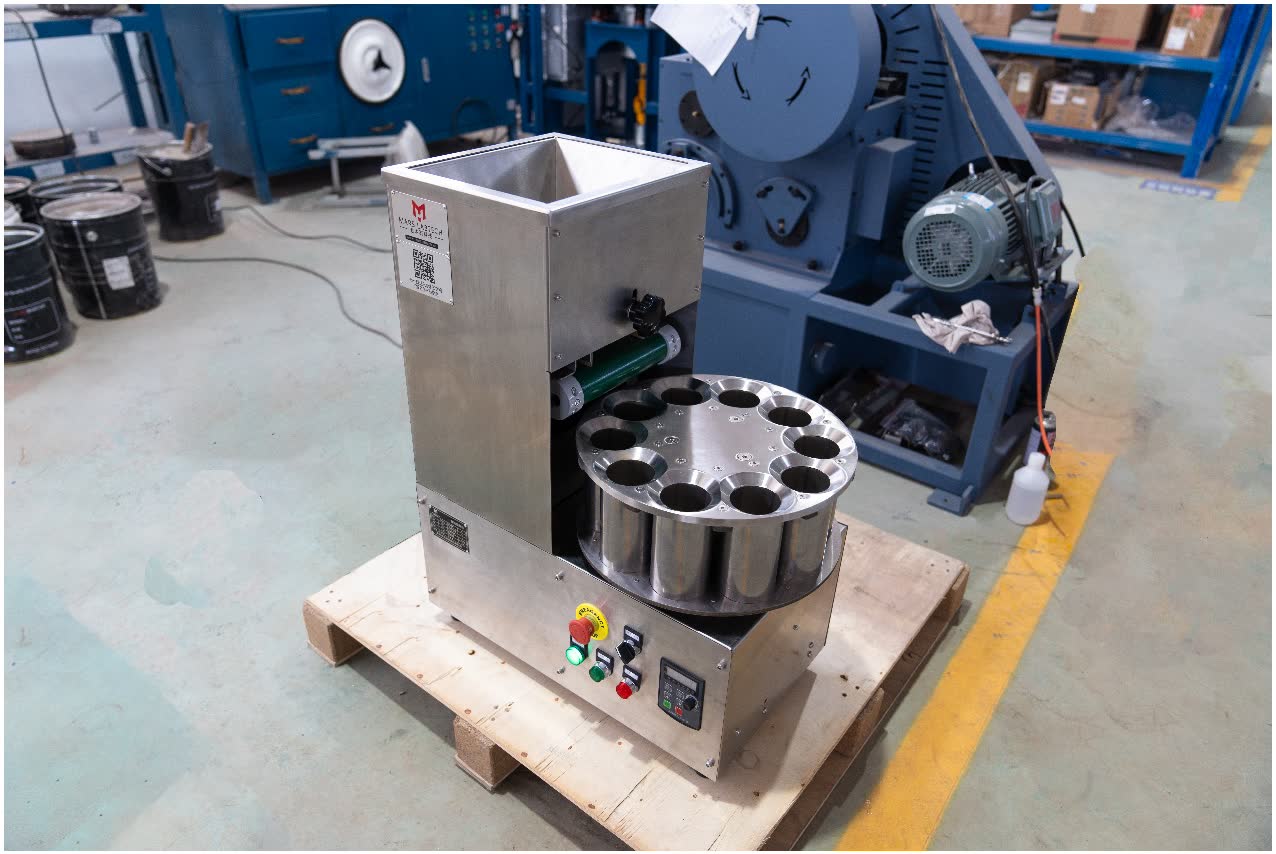
The DRSD05 Benchtop Rotary Sample Divider by Qingdao Decent Group embodies this evolved benchtop-scale rotary-division concept. It features adjustable stainless-steel vibrating feeding, equally-spaced quick-release capture-bucket assemblies in a compact bench-mount footprint. The unit suits medium-volume geochemical-survey specimens, mine-process-control samples and container-style mobile assay-laboratory workflows.
Product reference page: https://www.decent-group.com/product/benchtop-rotary-sample-divider/
Sample-division bias remains a substantial hidden source of error in mineral-assay data, affecting resource evaluation and commodity-trade outcomes worldwide. The technical journey from manual coning-and-quartering, via static riffle splitters, to modern benchtop rotary sample dividers represents a continuous pursuit of higher subsample representativeness and laboratory-process traceability.
Benchtop rotary dividers deliver distinct value for use-cases requiring multiple simultaneous replicate subsamples, but their reliable performance is conditional: stable controlled feeding, geometrically-accurate rotary capture assemblies, and thorough clean-able modular construction. Equally important, the equipment works only within its material-property operating envelope for free-flowing dry particulate samples. No mechanical divider can turn poorly-behaved, sticky, damp feedstock into representative subsamples.
Laboratory decision-makers should match hardware selection to actual sample matrices, required number of subsamples and sample-turnover frequency, rather than treating rotary dividers as a universal default solution for all mineral-sample-reduction workflows.
DECENT
DECENT
Visit us on social media:
LinkedIn
Instagram
Facebook
YouTube
X
Legal Disclaimer:
EIN Presswire provides this news content "as is" without warranty of any kind. We do not accept any responsibility or liability for the accuracy, content, images, videos, licenses, completeness, legality, or reliability of the information contained in this article. If you have any complaints or copyright issues related to this article, kindly contact the author above.
